Channel Partner Blog
13 August 2026
A Partner-Focused Guide for Microsoft Fabric, Copilot and AI Opportunities
Microsoft’s vision for enterprise AI has evolved beyond simply connecting large language models to data. Organizations are discovering that AI agents need more than access to databases and documents. They need business context. They need to understand customers, products, shipments, contracts, policies, processes, and relationships between them. This is where Fabric IQ enters the picture.
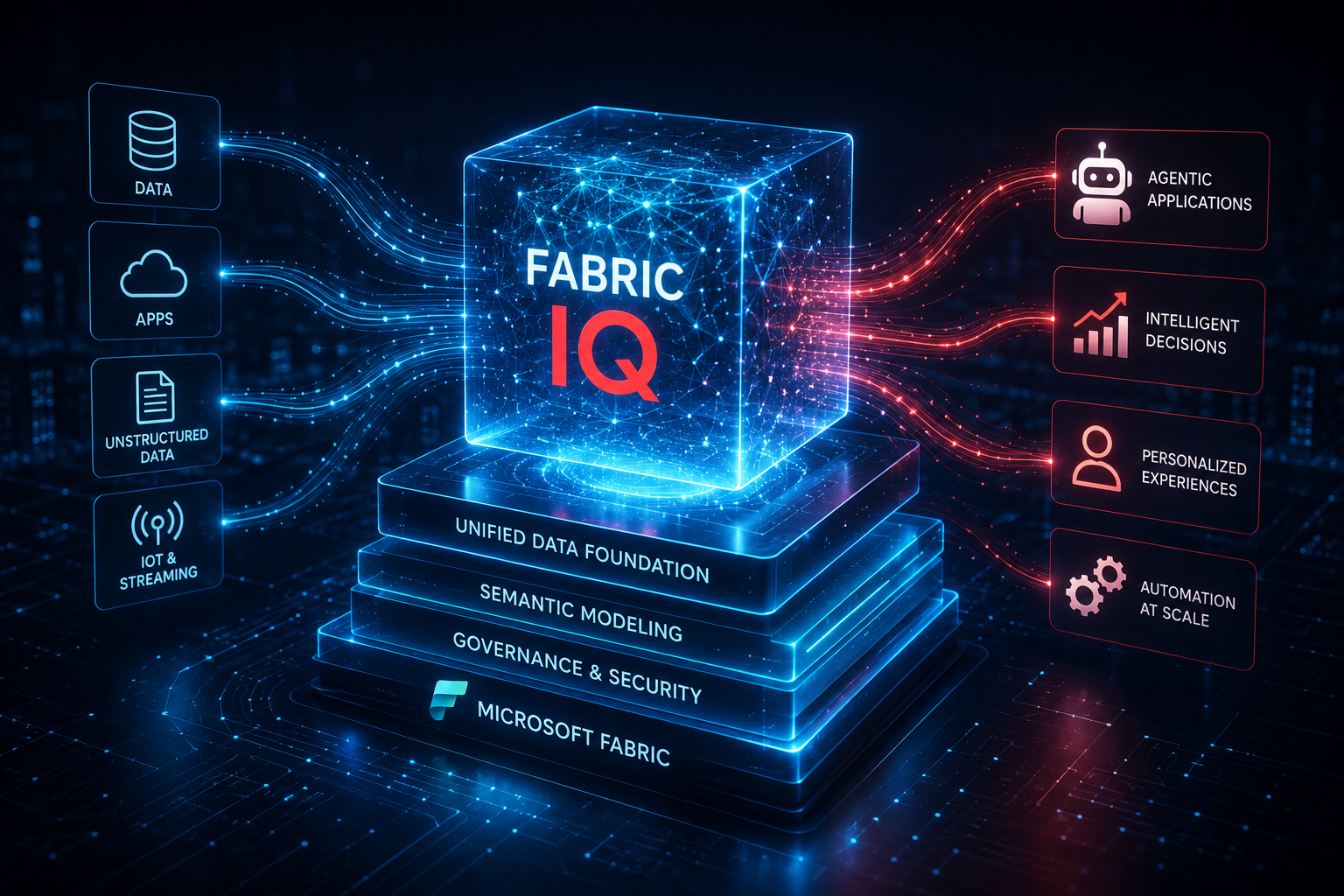
Announced as a major strategic component of Microsoft IQ and expanded significantly during Build 2026, Fabric IQ represents Microsoft's shared context layer for enterprise AI. It transforms Microsoft Fabric from a data platform into an intelligence platform by connecting data, business meaning, and operational actions.
What Is Fabric IQ?
Fabric IQ is part of Microsoft IQ, the enterprise intelligence layer across the Microsoft ecosystem. Fabric IQ works alongside Work IQ, Foundry IQ and Web IQ. Work IQ provides context about how employees work, Foundry IQ provides institutional knowledge and policies, Web IQ adds real-world information from the internet, while Fabric IQ provides context about business entities and business data.
The goal is simple: help humans and AI agents understand business information in business terms rather than database structures.
Instead of asking an AI model to interpret hundreds of disconnected tables, Fabric IQ allows organizations to define concepts such as Customer, Product, Shipment, Supplier or Contract and establish the relationships between them. Once defined, those concepts become reusable across Microsoft Fabric, Microsoft 365 Copilot, Copilot Studio and Microsoft Foundry.
Why Microsoft Built Fabric IQ
As organizations deploy AI agents, one challenge continually appears. Different systems store information differently. Sales data may exist in Dynamics, operational data in ERP systems, analytics in Power BI, and documents in SharePoint.
Traditional AI integrations often retrieve data, but lack sufficient understanding of business meaning. Microsoft describes Fabric IQ as a way to provide shared organizational context. Rather than each agent rebuilding its own interpretation of business structures, Fabric IQ creates one trusted knowledge layer.
For Microsoft partners, this is important because customers increasingly ask how Copilot, Fabric and AI investments fit together. Fabric IQ provides a compelling answer by creating a common intelligence foundation.
How Fabric IQ Works
Microsoft describes Fabric IQ as having three key layers.
Unified Data Layer
The first layer is powered by OneLake. OneLake acts as the unified data foundation, allowing organizations to connect information across cloud and on-premises environments. Through shortcuts, mirroring and centralized governance, data becomes accessible through a single logical layer.
Business Intelligence Layer
The second layer is powered by Power BI Semantic Models. Semantic models already define measures, dimensions, hierarchies and business metrics. Fabric IQ can use these models as a starting point for business understanding, ensuring reports, analytics and AI agents all speak the same language.
Operational Intelligence Layer
The third layer is delivered through Ontology. Ontology is arguably the most important Fabric IQ component because it captures business meaning.
An ontology defines business entities, properties, relationships, rules and actions. For example, a logistics company could define relationships between vessels, customers, shipments, ports and contracts. AI agents can then reason using those concepts instead of relying on technical table structures.
The Role of Ontology
Ontology sits at the center of the Fabric IQ architecture.
Think of ontology as a digital model of how an organization operates. It defines:
• Business entities
• Relationships between entities
• Business rules
• Processes
• Actions available to agents
Microsoft positions ontology as the operational intelligence layer that enables agents to understand the business context behind data.
This capability becomes especially powerful when combined with natural language experiences. An agent can translate a request such as "Which customers have delayed shipments above a specific value threshold?" into queries against business entities without requiring users to know databases or query languages.
Graph Technology and Relationship Intelligence
A major innovation within Fabric IQ is the introduction of Graph capabilities.
Graph technology focuses on connections instead of isolated records. Organizations often understand individual data elements but struggle to understand how everything is linked together.
Graph allows users to visualize and query complex relationships across business entities. This approach makes it easier to identify dependencies, process bottlenecks, supply chain impacts and hidden operational risks.
The recent General Availability milestone for Graph highlights Microsoft's commitment to making relationship-based intelligence a production-ready capability.
Simple Use Cases for Fabric IQ
Customer Service Optimization
A service agent asks: "Show me customers impacted by delayed shipments and open support cases."
Fabric IQ understands customer entities, shipment entities and support relationships. Instead of searching multiple applications manually, the agent receives a business-contextualized answer.
Executive Decision-Making
Leadership teams want real-time visibility into performance indicators.
Fabric IQ can combine operational events, semantic metrics and business context into a unified view. Executives can ask natural-language questions and receive insights grounded in trusted business definitions.
Supply Chain Monitoring
A manufacturing company monitors suppliers, inventory levels and logistics providers.
Operations Agents can identify disruptions, trace relationship impacts through graph technology and recommend actions using business rules defined in the ontology.
Financial Planning and Forecasting
With Planning in Fabric IQ, organizations can connect budgeting, forecasting and scenario modelling to shared semantic definitions. Rather than maintaining separate planning silos, teams work from a consistent intelligence framework.
Fabric IQ and Microsoft 365 Copilot
One of the most exciting developments is Fabric IQ integration with Microsoft 365 Copilot.
Customers often ask whether Copilot can understand the business beyond emails and meetings. Fabric IQ addresses this challenge.
When integrated with Microsoft 365 Copilot, Fabric IQ provides business context grounded in enterprise data. Agents can consume ontology-driven business understanding, improving decision support and operational awareness.
This creates powerful opportunities for partners building solutions around Copilot Studio, Fabric Data Agents and custom AI applications.
Latest Updates and Announcements
The most significant announcements between June and August 2026 include:
• Fabric IQ reached General Availability.
• Operations Agents reached General Availability.
• Graph reached General Availability.
• Planning became generally available with worldwide rollout.
• Ontology remains in preview but received expanded capabilities.
• Microsoft 365 Copilot integration expanded.
• Real-Time Intelligence integration expanded.
• OneLake remains a foundational architecture component.
• Agent-centric design became a major strategic priority.
These announcements reinforce Microsoft's direction toward enterprise agent ecosystems that operate from a shared understanding of business context.
What This Means for Microsoft Partners
For Microsoft indirect resellers, ISVs and solution providers, Fabric IQ creates several opportunities.
First, it strengthens Microsoft Fabric conversations by extending the discussion beyond analytics.
Second, it creates a bridge between data modernization projects and AI transformation initiatives.
Third, it provides a governance-first framework that many customers require before scaling AI agents.
Partner organizations can use Fabric IQ to position Fabric not only as a reporting platform but as the intelligence foundation that powers Copilot, agentic applications and operational automation.
Final Thoughts
The arrival of Fabric IQ marks one of Microsoft's most significant strategic shifts since the launch of Microsoft Fabric. Organizations no longer want AI systems that merely retrieve data. They want systems that understand how their business operates.
By combining OneLake, semantic models, ontology, graph technology, planning capabilities and AI agent integration, Fabric IQ creates a shared context layer that helps agents reason, decide and act based on business meaning.
For partners, Fabric IQ represents an important conversation starter with customers exploring Microsoft Fabric, Microsoft 365 Copilot, Copilot Studio and enterprise AI. The organizations that define and govern their business context today are likely to be the organizations that realize the greatest value from AI tomorrow.
Sources: Microsoft Learn Fabric IQ Documentation, Microsoft Learn What is Fabric IQ, Microsoft Fabric Team Blog Build 2026 Fabric IQ announcement, Microsoft Azure Blog Build 2026 Agentic Applications.
To learn more please reach out to our team at channel@4sight.cloud.
